Pages

Showing posts with label Parent Resources. Show all posts

Open House Night-FREEBIE

Last night we celebrated Open House!  Have you already celebrated yours?

In my school, children come with their families to visit their classrooms and visit different places in the school.  The classroom teachers have the children complete a scavenger hunt with their families to find places like the library, computer lab, cafeteria, and the gym.  Because we like to see the kiddos and their families too, the reading teachers are also placed on the scavenger hunts!  This year we had a few goodies waiting for the kiddos and their families when they stopped by.  

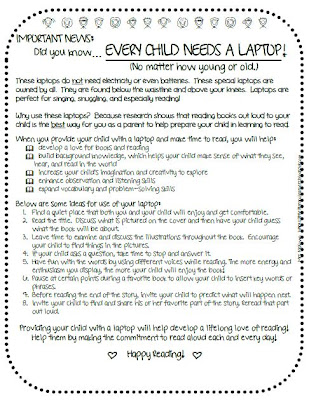
I created this first handout last year about every child needing a laptop.  Do you encourage your parents to provide laptops for their children?  You should!  They are free!  This handout definitely has a cute little twist that the parents enjoy as it discusses the importance of reading aloud to children, right on their own built-in laptop.  
If you missed the post from last year, you can check it out and grab your own copy by clicking on the picture above.

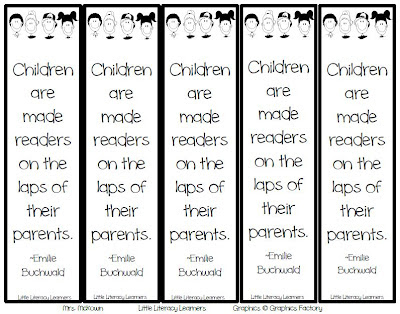
This year I created some bookmarks to go along with the handout, using the quote that I have seen floating around on Pinterest from Emilie Buchwald: 
"Children are made readers in the laps of their parents."  
I just love it and thought it fit perfectly!
We printed these bookmarks on colorful cardstock and the kids enjoyed taking these home.

I realize a lot of you have already celebrated Open House, but I could see these also being provided at parent conferences, literacy nights, etc...  What kind of handouts do you provide for the families of the children you work with?

Before I head off to bed because I am just absolutely exhausted, I wanted to share my new love with you!  
It is my new ruffle purse!
Isn't it adorable!!  I love, love, love the ruffles!!  It is another handmade bag that I found on Etsy from a shop called Gathered and Sown.  Angie was so easy to work with and I just love it so much that I had to share!  
What do you think!?  

And finally, don't forget to head over to TBA to check out the FREEBIES available for Freebie Friday!! 
Freebie Fridays

ABC Mouse

I was excited to be offered the opportunity to explore an educational website called ABCmouse with Paige and be able to share my experience with you! 
ABCmouse was developed by a team of educators especially for children ages 2 through 6.  It is a comprehensive site loaded with learning activities to address reading, math, science, social studies, art, and even music!


You begin by selecting a teacher avatar for your child along with creating an avatar to look just like your child.  
Paige had a lot of fun with this! 


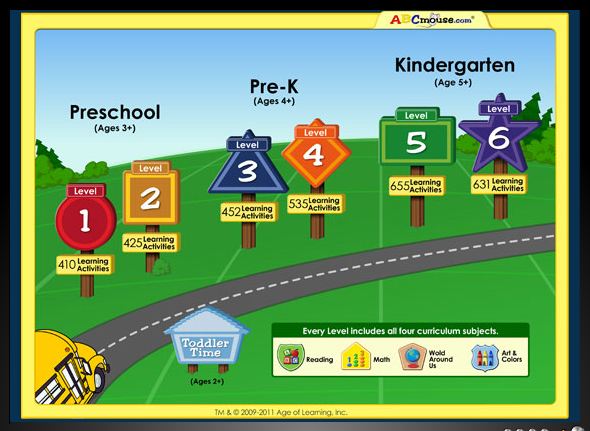
You then go on to choose the Learning Path for your child.  There are six different curriculum levels.  Preschool (levels 1 and 2), Pre-K (levels 3 and 4), and Kindergarten (levels 5 and 6). Each Learning Path provides a series of lessons where the child is guided from one lesson to the next.  They are set in different environments, pine tree forest, mountains, beach, etc... with activities to correspond with each environment.  The activities include books, art, puzzles, games, songs, and even printables.
 
As a parent or teacher, you can also build lessons with specific activities to customize the child's learning through Guided learning.

Paige can also choose the activities she wants to do on the website through Independent learning.  Outside of learning path she can do visit the farm, zoo, classroom, library, etc...  Even if she decides to go off of the Learning Path, each activity on the site has one or more learning objectives.  

Here are some of my favorite points about ABCmouse:
~  It is very easy to use for both adults and children alike.  I especially liked the mouse/pointer tutorial for children who are not familiar with using a mouse.
~  You can set up the account for up to 3 children with a parent account.  
~  You can track the progress of each child individually and create individualized lessons.
~  Creating the avatar that looked just like Paige along with an avatar for her teacher was lots of fun.
~  There is a ticket reward system!  After each activity is completed, the child earns a certain number of tickets.  They can then use these tickets to "shop" for decorations for their room and other things.
~  The child can save their favorite activities to revisit them in the future.
~  There is a Basics area that allows the child to practice their foundational reading and math skills.
~  The activities are fun and engaging.
~  The site is child safe.  There are no ads or links to external sites, providing a safe learning environment!
~  It is okay for the child to explore the site independently, not always sticking to the learning path because each activity on the site has one or more learning objectives.  

When I asked Paige what her favorite thing is about ABCmouse, she said:
"I like to go shopping (with the tickets she has earned) for furniture for my room, fish for my aquarium, and just shopping."
(I think she takes after Mommy here!)

I also learned that for a limited time you can set up a FREE classroom account for up to 40 students if you teach in a public or private school!
Click on the picture below to learn more!

Thank you ABCmouse for this opportunity!

Sight Words at Home

Do you agree that sight word instruction is a must when we are building the foundation for our little literacy learners?  Sometimes skill and drill is necessary, but I believe that it is important to make your instruction with sight words enjoyable.  I try to provide engaging activities that are hands-on to reinforce sight words in and out of connected text.  Because I work with students who are below grade level expectations, it is important that they are getting the extra practice in school with me, but it is also very helpful when they get additional practice at home. 

When I was writing up my report cards, I found that I was typing the same comment for many of my students :
"____ has made a small amount of progress with his ability to read sight words.  He is able to read ___ out of the 50 sight words kindergarten students are expected to know at the end of the year.  These are words that cannot be learned through pictures or by their sounds and appear frequently in all books.  It is important he learn these words and become automatic in identifying them.  Our goal is to have ____ read the sight words effortlessly.  On the back I have highlighted the words he knows.  Please practice the remaining words with ____ at home."

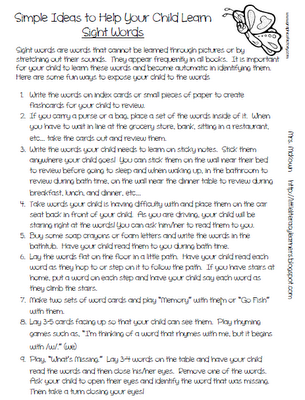
I think this is important information to share with parents, but I also wanted to provide suggestions of simple activities that parents could do at home with their children in case they didn't know how to practice the sight words at home.  This will help provide the children with much needed practice.  So I compiled a short list of activities I have come across throughout the years and will be sending it home with my report cards.


(Click on the picture below to grab your copy!)
Do you think you would find this useful as a parent?  If you decide to grab your own copy, I would love to hear your ideas!
~  What are some activities you use to help develop sight word vocabularies?
~  What are some ways you encourage  parents to get involved?

The End of Molasses Classes

I was asked to review, The End of Molasses Classes by Ron Clark. Can I just say his school sounds absolutely A....MA....ZING!  I think a slide in the middle of our foyer at home school would be so much fun!


 In this book, Mr. Clark provides 101 "Extraordinary Solutions for Parents and Teachers" to help get students "unstuck".  I wanted to take a moment to share two of the solutions that really touched me.  (I don’t want to give too much away in case you haven’t read the book yourself.)


His 12th Solution:  Set the tone for a love of learning.
This solution really brought me back to The Book Whisperer by Donalyn Miller and how much we need to instill a love, not only for reading, but for learning in general.  So many of my little learners do not have that love for reading or learning when they begin working with me.  We as teachers need to instill that in them.  I agree with Mr. Clark in that we need to show our students that we are lifelong learners and continue to have a constant thirst for knowledge.  We need to show them that even as adults there are still questions that we may not be able to answer, because we continue to learn things ourselves.  He states, "No one knows everything, and the real lesson we need to teach our children is that the man who can actually find the answers to any questions presented to him is the true genius."  It helps to reinforce the need for the students to try their hardest and do their very best every day.


His 13th Solution:  Treat every child as if he or she were your own.
I wholeheartedly agree with him when he says, "For anyone who works with children, we often are made aware of the burdens they have to bear, but in many instances we will never know.  We never have an awareness of the pain they are feeling and the struggles they have to endure.  What we can do, however, is love them and see them as individuals we care about and respect."
He says we can accomplish this by simply paying attention to them, asking them how they are, having lunch with them, or even giving a small gift.  He says, "It may seem like something simple at the time, but it may just end up being the most special moment in the life of a child who is desperately deserving of happiness."  All of the children we work with are such beautiful little beings and part of our job is to help them see themselves as such.


Some of his solutions seem so very simple.  But as simple as they are, they really help open our eyes to the many hats we need to wear as parents and teachers!  


Don't forget to stop by TBA to see what others have to say about this amazing book and how it has touched them!


~ Enjoy!

Handout-Reading Aloud and Laptops

We will be celebrating Open House with our families this week.  Last year I provided a handout about the importance of reading aloud to children to the kindergarten families.  After seeing and falling in love with this amazing post on Dr. Jean's blog, I went ahead and tweaked it a little bit to incorporate the need for every child to have a laptop....not the electronic device, but a laptop to sit on each and every night!!

Click on the picture below to access the download through my Teacher's Notebook shop:

Enjoy!

I Heart Summer...and Molasses!

Hello my long lost blogging friends!  
I am still alive and know I have been neglecting you.  So sorry.  To be honest, I have been taking some much needed time to thoroughly enjoy my last few weeks of summer vacation without too much thought about school!!

Just a couple of pics to share from a few of our happenings.  

We spent some time visiting the shore,

enjoying our boat,

and feeding the giraffes!

As for school, I did begin to put together one of my classrooms and received my updated teaching assignment.

I was also given the opportunity to review The End of Molasses Classes:  Getting Our Kids Unstuck--101 Extraordinary Solutions for Parents and Teachers written by Ron Clark.

Because I have been so busy, I haven't yet completed the book, but I wanted to take the time to share an excerpt from the book for now:

Not Every Child Deserves a Cookie
By Ron Clark,
Author of The End of Molasses Classes: Getting Our Kids Unstuck -- 101 Extraordinary Solutions for Parents and Teachers
Last year one of our new fifth graders was really struggling. He entered RCA below grade level in every subject and he was failing several courses. When I met with his mom she defended her son by saying, "Well, he made all A's at his other school."         When I told her that was shocking, she explained that he had done so well because he had a really great teacher. Urgh! 

There is a misconception in our country that teachers whose students make good grades are providing them with a good education. Parents, administrators, and the general communiry shouldn't assume good grades equal high academic mastery. In fact, in many cases those teachers could be giving good grades to avoid conflict with the parents and administration. It's easier to fly under the radar and give high grades than to give a student what he or she truly deserves and face the scrutiny of the administtation and the wrath of an angry parent. 

I have attended numerous awards ceremonies where practically every child in the class received an honor roll certificate. Parents always cheer, take pictures, and look so proud. I just sit there and think, Ignorance is bliss. Are these kids really being challenged, or are they only achieving mediocre standards set forth by a mediocre teacher in an educational system that is struggling to challenge even our average students? Yet, all of the parents look so proud and content. 

The worst part about it, however, is that I am afraid most parents would rather their child get a good education where they received straight A's and praise than an outstanding education where they struggled and received C's. 

At the beginning of every year, I give my fifth graders an assignment. They have to read a book and present a project on one of its characters -- specifically, they have to figure out a way to cleverly show such details as what the individual kept in his heart (what he loved the most), saw with his eyes (his view of the world), "stood for" with his feet, and held to strongly in his backbone (his convictions). I encourage the students to "bring it" and to use creativity and innovation to bring the body of the character to life. 

Most of the students will bring a trifold where they have drawn a body and labeled the locations. Some will use glitter, and some will be quite colorful. I am sure in most classrooms the projects would receive high grades, mostly A's and B's. I, however, hand out grades of 14, 20, 42, and other failing marks. The parents and students are always upset, and many want an explanation. 

I ask them to trust me, and I explain that if I gave those projects A's and B's, then the students wouldn't see a reason to improve their efforts on their next assignment. Some staff members have even said, "Ron, but you know what that child is dealing with in her home, and you know she did that project all by herself." I quickly tell them that society isn't going to make excuses for their home situations, and we can't either. If we make excuses and allowances, it will send the child the message that it's okay to make excuses for his or her performance based on circumstances, too. We just can't do it. We must hold every child accountable for high standards and do all we can to push the child to that level. 

I recall giving one fifth-grade student a failing grade on her first project. She cried and cried. She had never made less than an A on her report card, and her mother was devastated, too. I explained that the low grade would be a valuable life lesson, and I gave the young girl, and the rest of the class, tips and strategies for receiving a higher score in the future. I showed them an example of a project that would have scored 70, a project in the 80s, and a project that would have earned an A. 

I was pleased to see that her next project came to life with New York City skyscrapers that were sculpted from clay, miniature billboards that contained academic content, and streetlights that actually worked. The project was much, much better, and it received a 70. 

As a final project, the students were instructed to create a time line that would contain a minimum of fifty significant dates in the history of a specific area of the world. The same young lady brought in her final assignment wrapped in trash bags. Removing it, I saw a huge, four-foot pyramid, a replica of the Great Pyramid of Giza. The student had made it out of cardboard and apparently had used sandpaper to make it feel like a real pyramid. It was beautiful, but it didn't contain a time line, so I told her the grade would not be passing. 

She grinned at me, walked over to the pyramid, touched the top point, and suddenly three sides slowly fell open, revealing the inside. She had carved her outline on the inside, using detailed pictures, graphs, and descriptions of 150 major events. She even had hand-carved Egyptian artifacts and placed them throughout the inside of the pyramid, just as you would find in the tomb of a great pharaoh. She had handmade mummies that she had learned how to make on the Internet. She looked at me and said, "Mr. Clark, I have worked on this for weeks. I wanted it to be good enough. I wanted it to be an A." It was miraculous and spectacular. I looked at her, full of pride, and said with a smile, "Darling, it's an A." 

If her initial project hadn't been an F, she never would have walked in with that pyramid. That child is about to graduate RCA, and she is ready to compete with any high school student across the country. She knows what high expectations are, she understands the value of a strong work ethic, and she knows how to achieve excellence. If we continue to dumb down education and to give students A's and B's because they "tried," we are doing them a disservice and failing to prepare them to be successful in the real world. That young lady couldn't walk into an elite high school and compete with a glitter-filled trifold. However, she can walk into any high school with that pyramid and her overall knowledge of how to achieve that type of excellence and stand high above her peers. 

I often bake cookies for my students. I tell them it is my great-greatgrandma's recipe and that she handed it to me in secret on her deathbed. (Okay, a stretch.) As I pass out the cookies, the kids who are working hard receive one with delight; the students who aren't working as hard do not. Parents will call and say, "Mr. Clark, I heard you gave every child in the class a cookie except my child. Why are you picking on my child?" 

Why does every child have to get the cookie? The parents claim that I will hurt the child's self-esteem. Has it really gotten to the point that we are so concerned with our children's self-esteem that we aren't realistic with them about their performance and abilities? If we give "cookies" when they aren't deserved, then we are telling our young people that they don't need to work hard to receive rewards. We are sending a message that the cookie will always come. That is why we have so many young people in their twenties who have no idea what it means to work hard. And that is why they are still looking to their parents to provide support (and to give them the cookie). 

I tell my students who don't receive a cookie that I will be baking cookies the following week. I tell them that I will watch them until that time and that if they are trying hard they'll earn their cookie. It is shocking to see how much effort kids, regardless of their age, will display to get a cookie. And when it is earned, it means something. The students will glow with pride, and they will explain how they are going to eat half the cookie then and save the other half for later. Also, it tastes better than any cookie they have ever eaten, and it sends the message that with hard work comes rewards. If parents and teachers are just rewarding our kids without cause, we aren't teaching the value of personal effort. 

We all need to teach our young people that not everyone deserves a pat on the back just because we are attempting to make everyone feel good. Giving praise that isn't earned only sets up our students for more failure in the long run. 

If you are a teacher who wants to increase expectations but is afraid of the backlash from giving failing grades on assignments         that will cause your parents and administration to freak out, there are some steps you can take to protect yourself When you         give an assignment, show your students beforehand what you expect. Show a detailed description of what would earn a failing grade, a passing grade, and an outstanding grade. Share that with your administration as well to make sure it meets their approval, and then make your parents understand the expectations. Letting everyone know what is expected beforehand will leave no opportuniry for complaints after the grades have been given. 

If you are going to give rewards, such as cookies, let the parents know the classroom behaviors that will earn the reward and the behaviors that will not. When students are struggling, let the parents know specifically the areas that need to be addressed. If the child still does not meet the criteria, you have been clear about your expectations and therefore negative conflicts can be avoided. 

The above is an excerpt from the book The End of Molasses Classes: Getting Our Kids Unstuck -- 101 Extraordinary Solutions for Parents and Teachers by Ron Clark. The above excerpt is a digitally scanned reproduction of text from print. Although this excerpt has been proofread, occasional errors may appear due to the scanning process. Please refer to the finished book for accuracy.
Copyright © 2011 Ron L. Clark, Inc 
Author Bio
Ron Clark, 
author of The End of Molasses Classes: Getting Our Kids Unstuck -- 101 Extraordinary Solutions for Parents and Teachers, is a New York Times bestselling author of The Essential 55, has been named "American Teacher of the Year" by Disney and was Oprah Winfrey's pick as her "Phenomenal Man." He founded The Ron Clark Academy in Atlanta, Georgia, which more than 10,000 educators from around the world have visited to learn about the extraordinary ways that teachers and parents of RCA have helped children achieve great success.

For more information please visit http://EndofMolassesClasses.com and follow the author on Facebook and Twitter
We Give Books!

Have you ever heard of We Give Books?
This site also provides stories read aloud online.  Two wonderful things about it.  Number one, it is free (although you do need to create an account and sign in).  Number two, each time you read/listen a story through their website they donate a book to a child in need.  You can pick the campaign you would like to support.

What could be better than enjoying a story online, all the while you are helping to put a book into a child's hands?! 
Click on the picture above to check them out. 

The Kissing Hand Online

Do you love The Kissing Hand?

If so, did you know that Barnes and Noble is featuring Audrey Penn reading her book The Kissing Hand in their Online Storytime for the month?  They are!!
Click on the picture to go to their website.


New Blog for 1st Grade

I have found a fantastic BRAND new blog dedicated to the Common Core State Standards for 1st Grade that you have to check out and become a part of!  


Meesabelle from First Grade Frame of Mind created this blog for educators to list and search for free lessons and downloads aligned by the CCSS!


I know we have so many creative educators in the blog world, who all have lessons and materials to share.  To be a part of this, all you need to do is choose the lesson you would like to share, browse through the Common Core State Standards to find the standards your lesson correlates with, and then add your link!!  Directions are listed right on the blog!


You can also check out Meesabelle's blog here:


Thank you!

Online Storytime

I learned something new today!
Did you know that Barnes and Noble has an online storytime?  
These are stories read by authors and celebrities which can be played right on the computer and are FREE!

This month Molly Ringwald is reading a book called, Splish, Splash, Splat! written by Rob Scotton.

Just below the book of the month, you can click on books they have featured in the past and watch/listen to the story!
~ Enjoy!!

Exciting news!

I have some news to share with you!


Late last week I received an email about writing and submitting an article.  Summer learning loss was one of the topics.  So I went ahead an put together some practical tips for parents to incorporate reading and writing activities into the summer routines of their children.
And guess what?  It is published!!


You can view it here:


(This is rather exciting for little, ol' me!)


Thank you!