Pages

Showing posts with label Phoneme Isolation. Show all posts

Beginning and Ending Sounds Update

I am excited to share that I have updated my
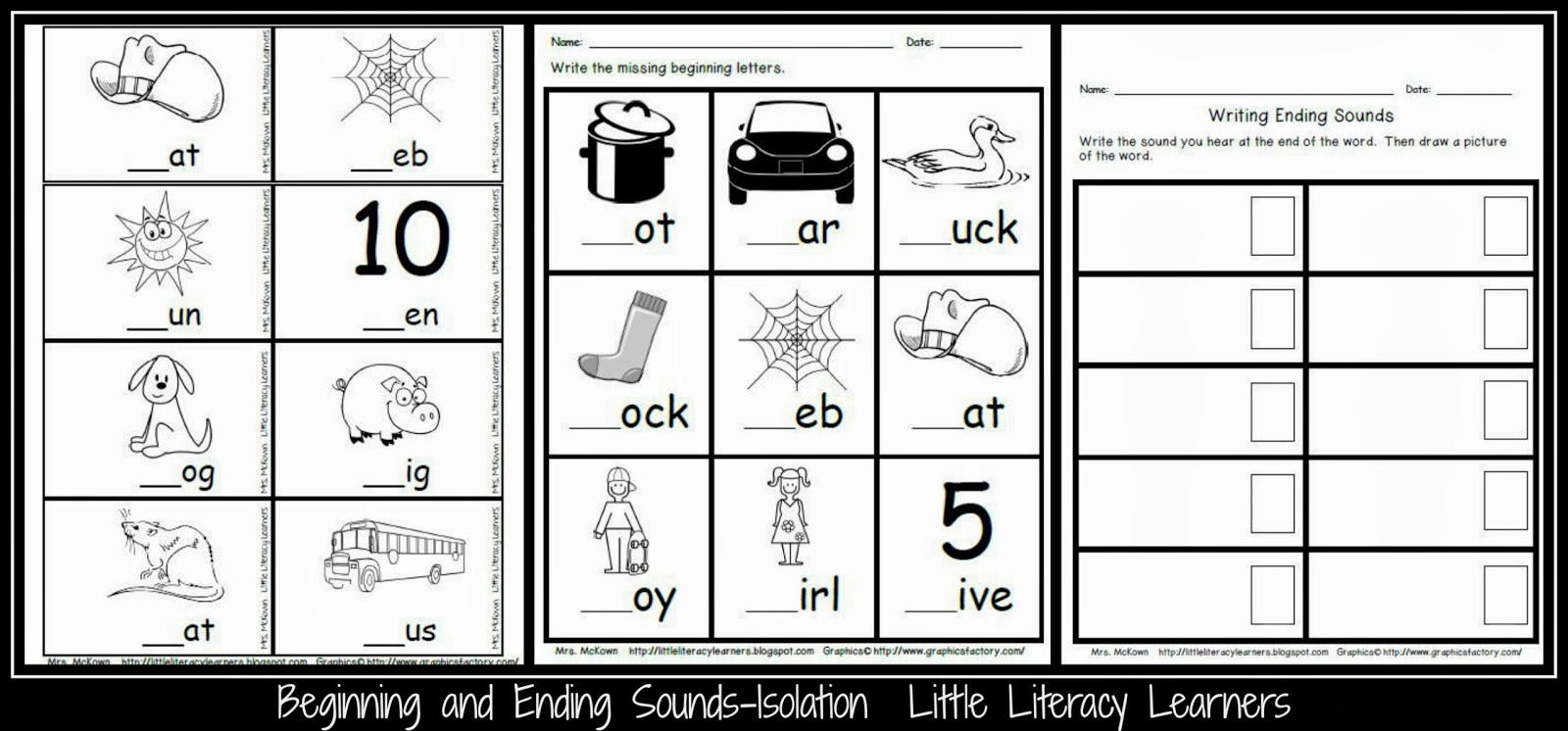
Beginning and Ending Sounds-Isolation 
pack today!
I made it twice as long!!
I made this pack to provide activities for my students to isolate the initial and final sounds (letters) in words.

This pack includes:
~  32 picture cards.  On each picture card, either the beginning or ending letter is missing.  I use these cards in a small group setting and ask the students to say the word, supply the missing sound, and then name the letter that makes the sound.
~  6 worksheets for independent practice.  Students look at the pictures and write the missing initial, final, and both initial and final letters (there are two worksheets for each skill).
~  3 worksheets for additional practice writing the initial, final, and both initial and final letters of a word.  There are no pictures on these worksheets, instead they allow you to dictate words for the students to write the targeted missing sounds.

If you already purchased this product from:
my TPT shop-click here.

Thank you!

Phoneme Isolation-Beginning and Ending Sounds

Before working on segmenting all of the phonemes in a word, children need to be able to hear the individual phonemes.  According to research, children develop their phonemic awareness on a continuum.  When kiddos start the phoneme level, they begin by listening for the sound heard at the beginning of a word, then the end, and then move onto the middle sound. 

 Many of my students are working to isolate and name the sounds they hear at the beginning and end of words.  They seem to do well with hearing sounds at the beginning of the word, but then tend to become confused when asked to name the sound at the end.

I updated my pack that helps students with the concepts of "beginning" and "ending" in words using the following visual:
I can't remember where I first came across the star with the arrow, but it is something I have used ever since with my little ones.  I have found that it is really helpful in making those concepts more concrete for the kiddos.

I begin my instruction by explicitly teaching the students how to use the visual through modeling.  Here are my general directions:
1.  Start with your finger on the star.
2.  Slowly stretch out (or say) the word.
3.  Slide your finger toward the arrow as you slowly stretch out the word.
I then repeat it again and again, showing that when you begin to stretch the word out, your finger is on the star.  And as you come to the end of the word, your finger is on the arrow head.

As students become more proficient with it, they generally internalize the visual and it is no longer needed.  (This is evident when you see them slide their finger across the table or even in the air.)


Here is what is included in this pack:
~  Star with arrow visual for teacher modeling.
~  Star with arrow visual for student use.
~  27 Picture cards for group work or sorting

~  6 Worksheets for independent practice that provides students with systematic practice as they develop their phoneme awareness (as listed below):
-  "What is at the beginning?"-all pictures begin with continuous consonants.
-  "What is at the beginning again?"-combined pictures of continuous and stop initial consonants.
-  "What is at the end?"-all pictures end with continuous consonants.
-  "What is at the end again?"-combined pictures of continuous and stop final consonants.
-  "Where is the sound?" and "Where is the sound again?"-combined tasks of beginning and ending isolation where the students identify where the sound is heard.

Please note that my initial instruction is based at the sound level.  This is when the students use the visual and picture cards to name the sound they hear.  As students gain knowledge in their letter sound correspondences, I then begin discussing what letter the word would begin or end with and introduce the worksheets for more independent practice.

How do you practice isolating phonemes?

Can Do! Phonemic Awareness Game Show

I am excited to be able to share my thoughts with you about Lakeshore's Can Do! Phonemic Awareness Game Show!
Although it is indicated for students in Grades 1-2, I played this with my kinderkids, who had so much fun practicing identifying and matching initial, final, and medial sounds.
I was able to put the software right into my computer and guided the student through the game.  

I liked that the 
Can Do!  Phonemic Awareness Game Show 
allows you to choose:
~  up to 4 different teams teams.
~  a futuristic player for each team.
~  the length of the game.  There are options to play up to 4, 6, or 8 points.
~  whether or not you want instructions to play throughout the game or not.
~  to print out a score report at the end of the game. This report is broken down by each category (beginning, middle, and ending sounds).
~  to print out a pre and/or post assessment.
My students had fun selecting a player to represent themselves.   When it was their turn, the robotic host told them to spin the wheel and answer a question to earn points.  Each time a question is answered correctly, something fun happens to the avatars of the other players (the Ice Device is activated, the Super Gooper pours cheese, ketchup, dish soap, or some other goopy material on the players, etc...)

Thank you Lakeshore for allowing me to review the 
It was definitely a hit and will be a great addition to help build my students' phonemic awareness!  I keep hearing, "Can we play that robot game again?"

St. Patrick's Day Literacy Activities

Here are some St. Patrick's Day themed activities that I will be using in the next few weeks to reinforce some foundational literacy skills.  Click on the pictures to learn more about each activity.

To help practice isolating and segmenting sounds, we will be using plastic gold coins to complete
St. Patty's Day Phoneme Segmentation:

To help practice letter and sound identification, letter writing, and phoneme isolation, my kinderkids will be completing activities from my newly updated 
Lucky Letters Literacy Pack:

And to informally assess correct responses to various phonological skills, I have my students
Color a Lucky Clover:

Lucky Letter Literacy Pack UPDATED!

In getting ready for St. Patrick's Day, I updated my Lucky Letters Literacy Pack! 

This pack includes upper and lower case versions of:
Lucky Letter Finds (alphabet charts)
Lucky Letter Mix-Ups (letters are mixed up)
Color the Lucky Letters ABC Paths
Write the Lucky Letters
It also includes worksheets for the students to circle the
beginning, ending, and now middle sounds of the words pictured.
I realized that some of the original pictures did not align with the Common Core Learning Standards (a few pictures ended with "l" or "r"), so I went ahead and changed them.  

Here are some of the Kindergarten Common Core Learning Standards that can be addressed when using the Lucky Letters Literacy Pack:
RF.K.1d- Recognize and name all upper- and lowercase letters of the alphabet.
RF.K.2d- Isolate and pronounce the initial, medial vowel, and final sounds (phonemes) in three-phoneme (consonant-vowel-consonant, or CVC) words.* (This does not include CVCs ending with /l/, /r/, or /x/.)
RF.K.3a- Demonstrate basic knowledge of one-to-one letter-sound correspondences by producing the primary sound or many of the most frequent sounds for each consonant.
RF.K.3b- Associate the long and short sounds with common spellings (graphemes) for the five major
vowels.
LS.K.1a- Print many upper- and lowercase letters.