Pages

Upper Case Letter Identification Freebie

Here is a fun activity for your students to independently practice their upper case letter identification and alphabetical order.
The students color a path, one square at a time, from A to Z.  As they color, the following box must be touching the last colored box.  I remind my students that if they get stuck, to head back to the beginning of the alphabet and recite the ABC's as they point to each letter.

This download includes two different versions.  In the first version, the students start at the snowflake and create a path to the snowman.  This path moves from top to bottom.  In the second version, students begin at the the bottom with a penguin and creates a path moving toward the top, to reach an igloo.

Hope you and your students enjoy!
Freebie Fridays

Beginning and Ending Sounds Update

I am excited to share that I have updated my
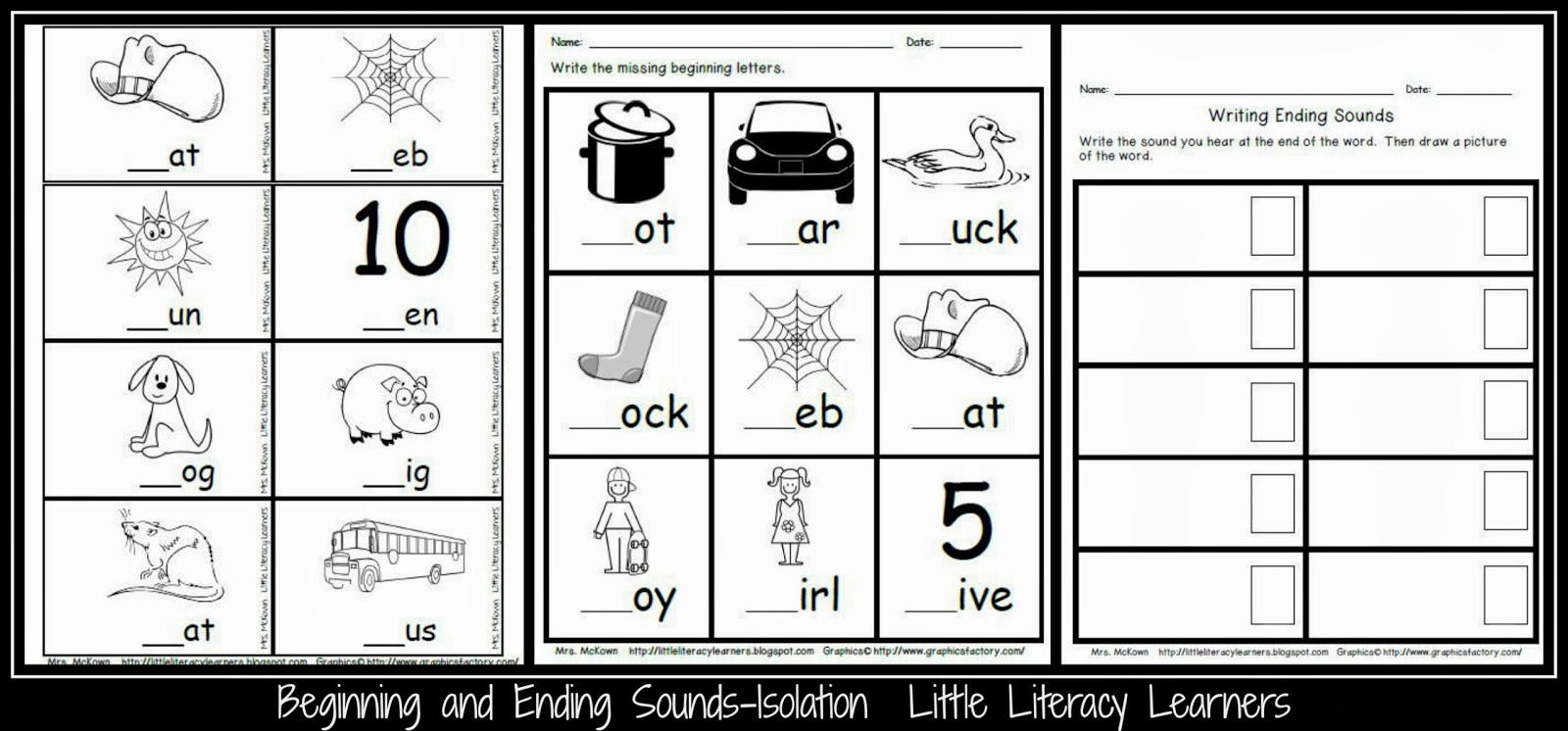
Beginning and Ending Sounds-Isolation 
pack today!
I made it twice as long!!
I made this pack to provide activities for my students to isolate the initial and final sounds (letters) in words.

This pack includes:
~  32 picture cards.  On each picture card, either the beginning or ending letter is missing.  I use these cards in a small group setting and ask the students to say the word, supply the missing sound, and then name the letter that makes the sound.
~  6 worksheets for independent practice.  Students look at the pictures and write the missing initial, final, and both initial and final letters (there are two worksheets for each skill).
~  3 worksheets for additional practice writing the initial, final, and both initial and final letters of a word.  There are no pictures on these worksheets, instead they allow you to dictate words for the students to write the targeted missing sounds.

If you already purchased this product from:
my TPT shop-click here.

Thank you!

Can You Help Me? New Student Reader

I'm excited to share the news that I just added a new title to my Emergent Student Readers-Set 1!

"Can You Help Me?" is a reader about a little boy who can not find his bat.  I know many kids will be able to relate to losing track of an item or two!
While reading, students will practice:
~  the sight words:  the, see, can, you, no, I, in, on, is, it, me, my, look, & like
~  concept of word
~  1:1 correspondence when reading
~  use of picture clues when reading
~ identification of basic punctuation and how it influences fluency

Don't forget, I have added this title to my Emergent Student Readers-Set 1, so if you've already purchased the set, head over to download it again!

If you want to learn more about the other Emergent Student Readers I have created, click on the "Student Readers" tab on the top right of my page or on the "Student Readers" Label on the right. 

Personalized Hand Sanitizer

What teacher doesn't keep a bottle of hand sanitizer handy?

To send along Christmas wishes, we made personalized hand sanitizer bottles for my daughter's teachers at school.
They are very easy to make!

Here is what we did:
First we bought the clear bottles of hand sanitizer and removed the labels.  (Goo Gone works great to remove those stubborn labels that just don't want to come off easily!)

Then my daughter did her magic and drew pictures for each teacher with a black sharpie.

Then I scanned the pictures into my computer and resized the drawings to a size that fit just inside the front of the bottle.  (You can skip this step entirely if you have your child draw a picture that size to begin with.)

Here is the important step:  Print/copy the picture onto an overhead with a laserjet printer/copier.  Do NOT use an inkjet, the printing will fall right off of the overhead and into the sanitizer/soap.  (We learned this the hard way last year!!)

Once it is printed, cut it to size and roll it up (with the writing facing forward).

Slide it into the opening of the bottle and use end of the soap dispenser to push it forward and move it into place.

Add a bow and you have a great personalized little gift! 

We had fun making these as gifts for family members last year using clear hand soap!

Decorating the Seasons

I have been having so much fun decorating this year!  
Not only does it make the children smile, 
but the the adults enjoy it too!

Who likes snowmen?  I really do!  

This is who is on our door right now:
(I apologize for the poor quality of this photo.)

This is who is on our refrigerator at school:


And of course I had to build one at home, too:


And finally, this is who was on our door before the invasion of all the snowmen!

Phoneme Isolation-Beginning and Ending Sounds

Before working on segmenting all of the phonemes in a word, children need to be able to hear the individual phonemes.  According to research, children develop their phonemic awareness on a continuum.  When kiddos start the phoneme level, they begin by listening for the sound heard at the beginning of a word, then the end, and then move onto the middle sound. 

 Many of my students are working to isolate and name the sounds they hear at the beginning and end of words.  They seem to do well with hearing sounds at the beginning of the word, but then tend to become confused when asked to name the sound at the end.

I updated my pack that helps students with the concepts of "beginning" and "ending" in words using the following visual:
I can't remember where I first came across the star with the arrow, but it is something I have used ever since with my little ones.  I have found that it is really helpful in making those concepts more concrete for the kiddos.

I begin my instruction by explicitly teaching the students how to use the visual through modeling.  Here are my general directions:
1.  Start with your finger on the star.
2.  Slowly stretch out (or say) the word.
3.  Slide your finger toward the arrow as you slowly stretch out the word.
I then repeat it again and again, showing that when you begin to stretch the word out, your finger is on the star.  And as you come to the end of the word, your finger is on the arrow head.

As students become more proficient with it, they generally internalize the visual and it is no longer needed.  (This is evident when you see them slide their finger across the table or even in the air.)


Here is what is included in this pack:
~  Star with arrow visual for teacher modeling.
~  Star with arrow visual for student use.
~  27 Picture cards for group work or sorting

~  6 Worksheets for independent practice that provides students with systematic practice as they develop their phoneme awareness (as listed below):
-  "What is at the beginning?"-all pictures begin with continuous consonants.
-  "What is at the beginning again?"-combined pictures of continuous and stop initial consonants.
-  "What is at the end?"-all pictures end with continuous consonants.
-  "What is at the end again?"-combined pictures of continuous and stop final consonants.
-  "Where is the sound?" and "Where is the sound again?"-combined tasks of beginning and ending isolation where the students identify where the sound is heard.

Please note that my initial instruction is based at the sound level.  This is when the students use the visual and picture cards to name the sound they hear.  As students gain knowledge in their letter sound correspondences, I then begin discussing what letter the word would begin or end with and introduce the worksheets for more independent practice.

How do you practice isolating phonemes?

New Updates-I See Student Readers!

Are you familiar with my Emergent Student Readers?  
I use them throughout the year to help develop my students into readers.

Each year I start my students off with the following reader:
This reader practices the sight words:  I, see, the, a.
I use it to reinforce:
~  concept of word, sentence, and space
~  1:1 correspondence when reading
~  use of picture clues when reading
~  rhyming
~ onset-rime blending

This year I added another reader that is very similar, yet different:
This reader reinforces the sight words:  I, see, my, a,
along with the same concepts written above.

How do I use these?
I begin my instruction by writing out each sentence on a sentence strip.  I attach the corresponding picture and display them in my pocket chart.  We review the sight words in the reader and discuss the use of picture clues if we become puzzled on a word.  Then we name the pictures shown.

I model how we read by pointing to one word at a time and we read through each sentence together.  I then have each student come up and read with a fun pointer.  Once each student has read, I give them each a copy to begin their Student Reader folder.  

As additional Student Readers are introduced, I will add them to the folder.  Each week the kiddos go through and read through their folders independently to practice fluency.

I will also have them take their Home Reader home with them to read to someone special.

I have combined the two readers into one download:
If you had already purchased the first "I See" Emergent Student Reader, please go back to download the file again so that you can receive the second "I See" Emergent Student Reader!!


Click on the picture below to see all of the Student Readers I have created:
 

A Letter ID Game for the Entire Year!

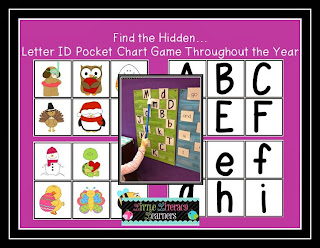
As a Reading Teacher who works with Kindergarten students who are below grade level, I tend to work on letter and sound identification throughout the entire school year.  One way I do this is by playing a fun pocket chart game all year long that they just LOVE!  
Here is how to play:
~  Display the target letters on a pocket chart.
~  Choose your picture to "hide" and place it behind one of the letters.
~  Have your students take turns pointing to one of the displayed letters and naming it (and the sound sound).
~  If identified correctly, remove the chosen letter to see if the graphic is hiding behind it!

Here is a close up of the game in use in my classroom:
It is really, very simple!  I will use the same letter cards but change the graphic to go along with the seasons or holidays of each month!  The kids love trying to find the hidden picture!  (The first round of each new month is really fun because I don't tell them ahead of time what is hidden!)

Another nice thing about this game is that I always have it displayed in my pocket chart.  So if I have an extra few minutes here or there, we play a quick game.  The kids have fun and it is reinforcing their letter-sound knowledge! 

I created a document that puts all of the letter cards and pictures together in one download.  The download includes:
-  Cards for the 26 upper and lower case letters.
-  12 pictures to correspond with monthly holidays and/or seasons to hide behind the letter cards.

The uses of this game are endless!  I personally use it with sight words, sight word phrases, and CVC words.  It could be used with numbers, math facts, vocabulary words, etc...  Have you played this game before?

Rhyming Activities Pack

I have been working hard with some of my kinderkids to build their rhyming skills.  I have been reading aloud lots of rhyming texts, chorally reciting rhyming poems and chants, and playing games.

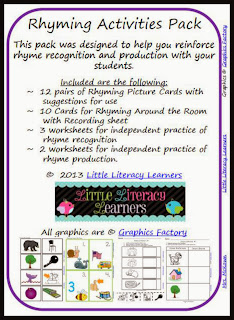
I decided to update my Rhyming Activities Pack and made it bigger (and better)!


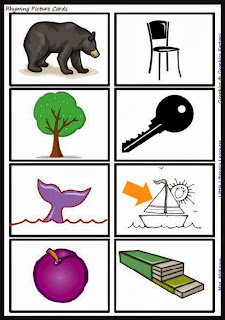
I tend to do a lot with picture cards in my small groups, so I decided to add more.  Now there are 12 pairs of Rhyming Picture Cards along with suggestions for use.  


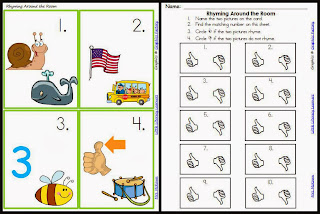
I also added 10 cards for a Rhyming Around the Room game.  My kiddos LOVE having a clipboard in their hands, so this activity is fun and engaging for them!


To help provide some independent practice of rhyme, I also included 3 worksheets for rhyme recognition and 2 worksheets for rhyme production.  So that is a total of 5 sheets for them to show me what they can do independently!

What are some fun rhyming activities you do with your kiddos?

Letter Identification with Alphabet Charts

As a reading teacher, I work with many kindergarten students who come to school having little to no exposure to the alphabet.  So in addition to building their critical phonemic awareness skills, I spend a lot of my time exposing them to letters. 

The first place I like to start with my kiddos is with the 
ABC Song and an alphabet chart.  
We begin by singing the traditional melody of the ABC Song because many of the children are familiar with it.  (However there always seems to be a child or two who is not, so the extra practice and reinforcement is generally helpful to all.)  As we sing the song, we point to each letter of the alphabet.  This can be challenging at first, especially for the little ones who do not yet realize the relationship between the letters they are speaking and the letters in print.  It is important to slow the song down so that each letter can be heard, especially the L-M-N-O-P.

We use many different tools for this activity, including fun pointers, our own fingers, alphabet strips, and alphabet charts.  As the students become more proficient, we use different ABC songs and gradually transition into reciting the alphabet (removing the melody and pausing at the end of each row), while pointing to each letter.  

Seems pretty simple, doesn't it?  Alphabet charts provide so many opportunities for teachable moments!

I like working with alphabet charts in this manner for two main reasons:
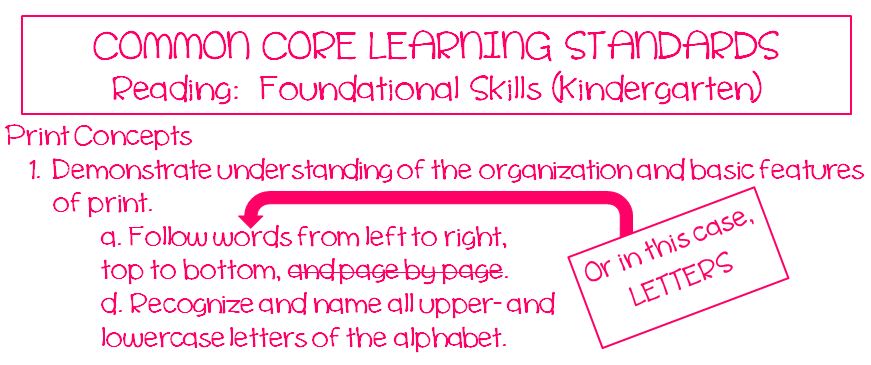
First, this helps to build understanding of the organization and basic features of print as they follow the letters from left to right and top to bottom.  (Sound familiar to anyone?)  Not only are they improving their ability to recognize and name the upper and lower case letters of the alphabet, but they are tracking print from left to right (understanding directionality), tracking print from the end of the line to the beginning of the next (return sweep), 
and pointing to individual letters (using one-to-one correspondence).  These are big skills for our little literacy learners!
Secondly, this activity provides the students with a strategy to use to help them figure out unfamiliar letters on their own.  Almost every classroom environments are rich in print.  Every classroom in our building has the alphabet posted and most students have the alphabet printed on their name tags at their seats.  So as long as they have the alphabet in front of them and can recite or sing the ABC Song as they point to the letters, they will have a means to name unknown letters.   

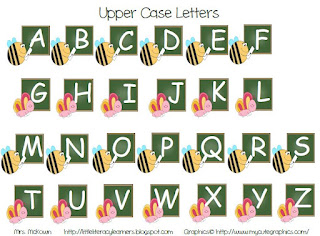
Here is a FREE Alphabet Chart to share with you!  To help our little literacy learners develop return sweep, you will see that I alternated the bee and the butterfly for each row.

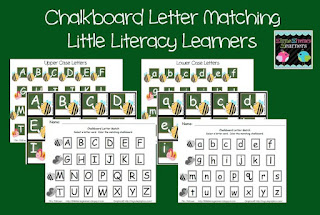
I also created some letter cards and letter matching/identification worksheets to go along with the alphabet charts.  
You can find them here:
(Here is the link for my TPT shop.)

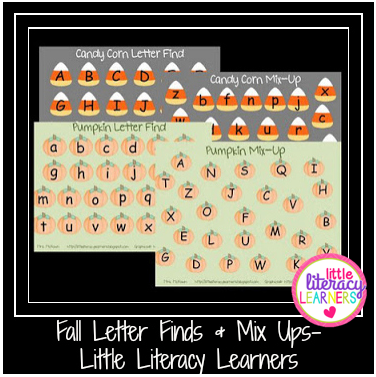
Here are some links to other letter matching/identification activities I have made to go along with the Fall that include alphabet charts:


 Do you use alphabet charts yourself?  Where do you start with the children who come into school who have had little to no exposure to the alphabet?